Storage and packaging
Crackit ships as four 5 kg moisture-barrier bags inside a waterproof 20 kg carton.
- Even in sealed bags, long storage in humid conditions can reduce performance. Keep cartons dry and use stock within a year.
- Never stack bags directly on the floor — palletise and store in a dry warehouse. Properly stored product remains effective for about 12 months.
- Open bags in a low-humidity area right before mixing.
- Reseal partial bags tightly after use and use them soon. Once opened, moisture exposure can weaken the powder.
- Reject torn or water-damaged bags — moisture may have already activated the mix.
On-site handling
- Wear safety glasses, rubber gloves, and a dust mask in enclosed spaces.
- Stay clear of filled holes for 2–3 hours — splatter or blow-outs are possible in hot material.
- Store dry and mixed material away from heat sources.
- Match the product grade to your measured hole temperature.
Tips for better results:
- Pour steadily and agitate the slurry so no air pockets remain in the hole.
- Fill to within about ½ inch of the surface — not overfilled.
- In summer, pour early morning or evening when the rock is coolest. Hot material increases blow-out risk.
- Shade filled holes with tarpaulin or wet hay in direct sun.
- On very hot days, chill mixing water with ice before adding powder.
- Some contractors add extra water on certain materials to stretch coverage — test first on a small section.
- Measure both air temp and material temp inside the hole — they are often different. Don't guess. Tie a string to a thermometer and lower it into the bore.
- In winter, 1% calcium chloride can be added to the mix.
- If powder in a hole has dried without cracking, add water to the filled bore.
- Never mix in glass jars, metal cans that narrow at the base, or any container that could shatter under pressure.
- Never pump Crackit under pressure.
- Hand mixing takes longer and increases blow-out risk — use a mechanical paddle when possible.
- Above 23°C material temperature, add ~150 ml extra water per 5 kg bag.
- Clear drill cuttings from every hole before filling.
- For marble, drill to 95–98% of block depth.
- Need faster results? Add more holes, closer together.
- Standard mix: 1.5 litre clean cold water per 5 kg powder.
- Stir continuously to prevent lumps.
- Pour within 10 minutes of mixing.
- Cover filled holes with tarpaulin in direct sunlight.
- After 2 hours, a little cold water in the holes can accelerate cracking.
- One 5 kg bag + 1.5 L water ≈ 2.68 L slurry — enough for ~11 ft of 32 mm hole.
- Shelf life is 1–2 years in dry storage depending on humidity and temperature.
- Every site is different — a short test break on your actual material beats any generic chart.
Safety on site
- Use Crackit only for breaking rock and concrete — not for any other purpose.
- Crackit becomes highly alkaline (pH ~13) when mixed with water. Rinse skin immediately with plenty of water; seek medical help if it contacts eyes or mucous membranes.
- Wear safety glasses, rubber gloves, and a hard hat during mixing and filling. Use a dust mask in tunnels or poorly ventilated cuts.
- Never pour Crackit into bottles or cans and leave it — pressure can rupture the container.
- Keep your face away from filled holes for at least 3–6 hours. Blow-outs are most likely when material temperature exceeds chart limits.
- Protect holes from rain and direct sun with tarpaulin only — not heavy coverings that trap heat.
- Do not use hot water for mixing.
- Mix no more than one 5 kg bag at a time.
- Confirm you have the correct grade for measured temperatures.
- Keep product away from children and animals.
Field notes
- For ledge work, Crackit plus a hydraulic hammer is often the most economical approach — holes can be spaced wider.
- Underwater demolition: build a cofferdam, pump the area dry, fill holes, wait 15–20 minutes for initial set, then flood again if needed.
- Crackit must go into drilled holes — pouring into existing surface cracks won't work.
- Safety glasses for everyone in the work zone; hard hats and steel-toe boots recommended on active demolition sites.
- Holes in sun or near running equipment read hotter than air temperature — measure in the bore, not with a weather app.
- Cold weather, hard rock, or wide hole spacing all extend break times. If nothing happened overnight, wait — pressure keeps building for 24–28 hours.
- Steam rising from the bucket means the mix is going off too fast — add ~½ gallon water, stir, and discard. You waited too long between mixing and pouring.
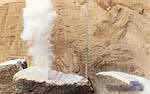
- Smoke or steam from filled holes signals a possible blow-out — clear the area immediately. The vapour is steam only, not toxic.
Blow-outs — causes and prevention
Common causes
- Hole diameter too large for the temperature range.
- Mixing water too warm — check the temperature chart.
- Too little water when material is above 23°C.
- Too long between starting the mix and filling holes.
- Hand mixing instead of mechanical stirring.
- Guessing hole or water temperature instead of measuring.
- Holes shallower than 4× diameter.
- Powder stored in heat before use.
- Skipping sections of this manual.
- Holes closer than 10″ apart in soft rock or concrete on hot days.
- 1½″ (38 mm) diameter is the most reliable bore size.
- Blow-outs rarely happen more than 3 hours after filling.
How to avoid them
- Match product grade to measured material temperature.
- Keep powder away from heat, sun, and warm vehicles before mixing.
- Cool powder bags before use if they've been in a hot store.
- Mix in a wide metal bucket — not narrow plastic containers.
- Cool mixing tools before you start.
- Use 1.5 litre water per 5 kg bag unless the chart says otherwise.
- Never use hot water.
- Hand-mix two bags (10 kg) maximum per batch.
- Mix at least 2–3 minutes until lump-free.
- If the slurry stiffens, add a small amount of water — don't exceed ratio limits.
- Fill all holes within 5 minutes of finishing the batch.
- Don't overfill bores.
- Don't tamp or ram filled holes.
- Don't plug holes with setting mortar after filling.
- Never pour mixed Crackit into glass bottles — dilute and discard unused mix with plenty of water on open ground.
 Loading